Furniture has never been easy to sell online. A customer might be choosing a sofa based on the dimensions of their living room, a designer might be specifying finishes across an entire project, or a hospitality buyer might be evaluating hundreds of pieces against a set of requirements. The product may be the same, but the buying journey is not.
That complexity is what makes home furnishings different from many other categories. And it is also why the traditional product page is starting to fall short.
Today, customers need more than a list of specifications and a collection of product images. They need help understanding their options, visualizing the outcome, comparing configurations, collaborating with others, and ultimately feeling confident that they are making the right decision.
The technology to support that experience already exists. The bigger opportunity is connecting it in a way that actually reflects how people buy furniture. The gap isn't product information; it's product context.
Recent research from Threekit, an AI-native CPQ platform for configurable products, highlights just how much room there is to improve the digital buying experience for configurable products.
Across 135 large configurable-product manufacturers, the average site earned just 35 out of 100 on Threekit's "Easier to Sell Index." Only 14% were considered "actively selling," meaning guidance, configuration, and handoff were working together as part of the experience.
The findings point to a broader issue: brands have invested heavily in product information and digital capabilities, but those capabilities don't always translate into an experience that makes the buying decision easier. That's particularly relevant in furniture, where the number of choices can quickly become overwhelming.
Fabric, finish, size, configuration, material, leg style, accessories, placement. That's just a sample of the options.
The challenge isn't simply giving customers access to all of those options. It's helping them understand which options matter to them and what the finished product could actually look like.
That's the shift from product information to product confidence.
It's also the problem configure-price-quote (CPQ) software was built to solve: making sure every combination a customer chooses is valid, buildable, and correctly priced. For years, though, that logic lived behind the sales desk. AI-native CPQ platforms like Threekit bring it to the front of the experience, so the rules that govern what can be built also shape what the customer sees and chooses.
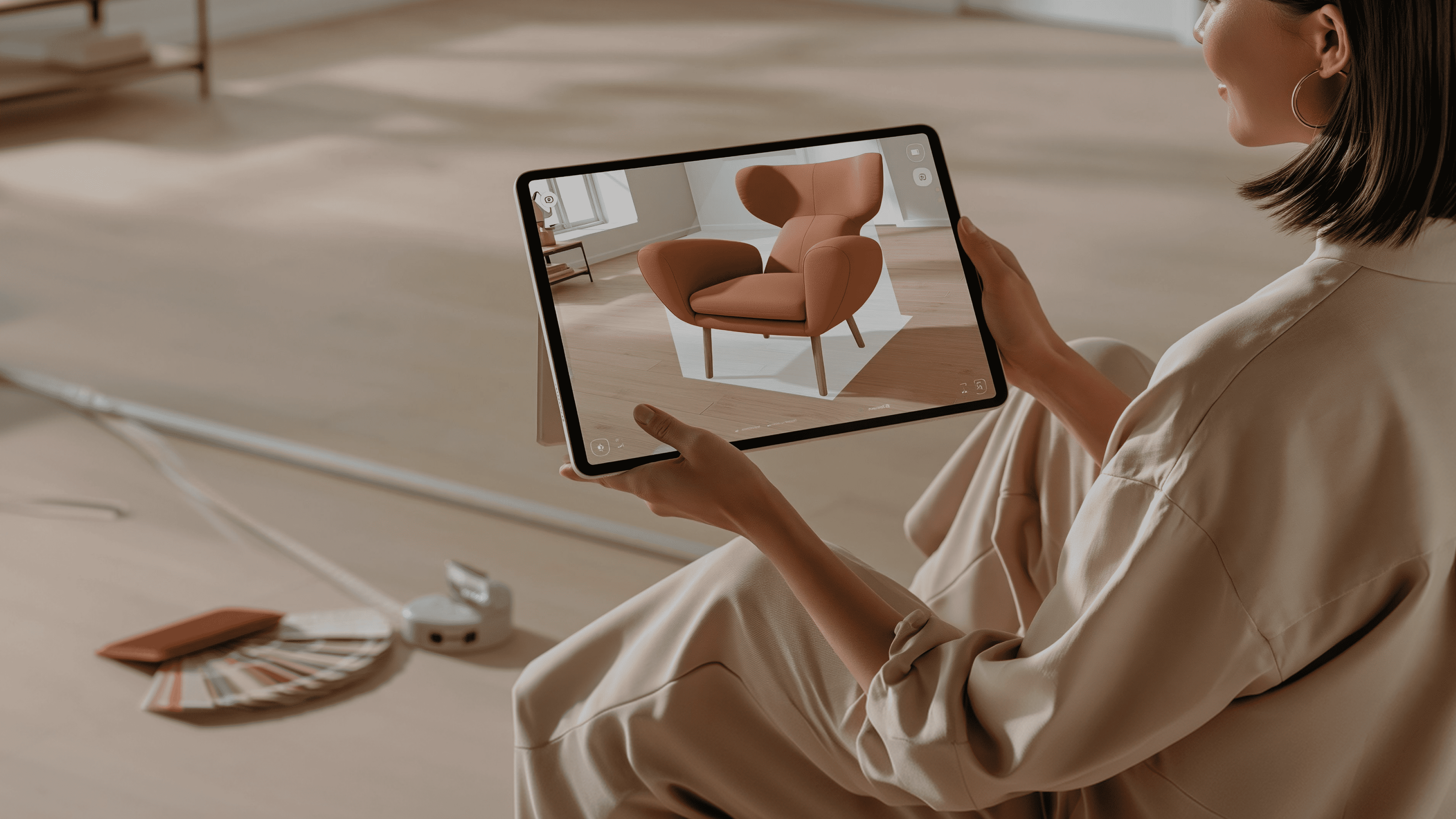
Configurators, visualization tools, and product data are becoming increasingly important in furniture commerce. But they shouldn't exist as isolated features. A configurator that lets someone change a sofa's fabric is useful. A configurator that helps them understand how that sofa will work in their space, visualize the result, save it, share it with a partner or designer, and move seamlessly toward purchase is much more powerful. The same principle applies to visualization.
Showing a customer what a product looks like in isolation answers one question. Showing them what it could look like in their environment helps answer the question they actually care about:
"Is this right for me?"
That distinction matters.
The goal isn't to add more technology to the product page. It is to leverage technology to support the customer's decision. Personalization features need to be more useful. This is where the conversation around personalization also needs to evolve.
For years, personalization in commerce has largely meant recommending products, changing content, or creating audience segments.
But furniture customers don't necessarily think in segments.
They think in projects.
"I'm furnishing a new home."
"I need a sectional that works in this space."
"I'm designing a hotel."
"I'm replacing everything in this room."
"I'm a designer trying to specify the right product for my client."
Those intentions should shape the experience. The more context a brand can bring together across customer data, product information, commerce, configuration, and behavioral signals, the more useful that experience can become.
Instead of simply showing a customer a different product, the experience can help them navigate the decision itself.
That is personalization with a purpose.
For trade and contract buyers, the next step usually isn't a cart. It's a quote. A designer specifying finishes for 40 guest rooms needs accurate pricing and a formal proposal, ideally without waiting days in a sales queue. An AI quoting agent, like the one in Threekit's CPQ, can turn a saved configuration or a full project list into a validated, priced quote, so the experience keeps moving at the buyer's pace.
AI has the potential to take this even further, but only if it understands the products.
Threekit's research found that just one of the 135 companies studied had an AI assistant grounded in its own product catalog.
A generic AI assistant can answer questions. A product-aware AI experience can help someone make a decision. Imagine being able to ask:
"I need a sectional for a small living room. I want something durable, comfortable, and easy to clean. What configurations should I consider?"
The value doesn't come from AI simply generating an answer. It comes from connecting that conversation to real product data, real configurations, real availability, and real commerce workflows. That is where AI moves from another interface to part of the buying experience.
That's the thinking behind Threekit's web agent: an AI assistant that works from a brand's own catalog and configuration rules, so everything it recommends can actually be built, priced, and ordered. Instead of a list of links, the shopper gets a suggested configuration they can see, adjust, and take straight to purchase or a quote.
The Next Generation of Furniture Commerce Will Connect the Pieces
The opportunity for home furnishings brands isn't to choose between commerce, personalization, configuration, visualization, data, or AI. It is to make those capabilities work together.
The product catalog provides the intelligence, configuration gives customers control, CPQ keeps every choice valid and priced, visualization gives them confidence, and customer and behavioral data provide context.
AI can help bring it together in a way that feels more natural and responsive. When those pieces remain disconnected, customers are left to do the work themselves.
When they work together, the digital experience starts to behave more like a knowledgeable salesperson, designer, or showroom associate.
Furniture is personal. The digital experience should be, too.
The brands that create that experience won't necessarily be the ones with the most technology. They will be the ones that make their technology understand the customer, the product, and the decision they are trying to make.
Ready to Make Furniture Easier to Buy?
The right digital experience can turn product complexity into customer confidence.
Astound Digital and Threekit help home furnishings brands connect commerce, product data, configuration, and visualization to create more guided, personalized buying experiences. Astound brings the commerce and experience strategy; Threekit brings AI-native CPQ, 3D visualization, and AI agents that guide shoppers on the web and turn configurations into quotes.